Water Heater Expansion Tank in Greer, SC
When a water heater's relief valve drips, thermal expansion is a common cause, and the big Upstate water utilities set houses up for it by putting a check valve or backflow preventer at the meter. We install and replace thermal expansion tanks, with the air charge set to your home's water pressure.
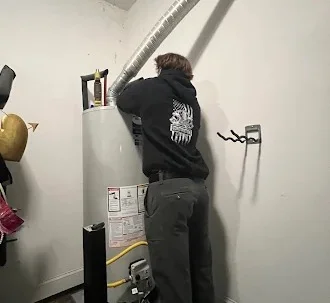
About This Service
Water expands as it heats. In an open system, that extra water pushes back into the utility's main. Around here, a check valve usually stops it: Greenville Water has required backflow prevention assemblies on all service connections since 1971, and Spartanburg Water and Greer CPW have installed dual check valves on residential 3/4-inch services since 1985. Each utility's cross-connection manual says the same thing: with that device at the meter, the house is a closed system, and thermal expansion often makes water heater relief valves discharge, usually above 150 psi. A pressure-reducing valve or water softener with a check valve closes the system too.
South Carolina's residential code requires a device for controlling that pressure wherever a backflow preventer, check valve or other device on a system with a storage water heater lets thermal expansion raise the pressure, and wherever expansion pushes the pressure past a pressure-reducing valve's setting. The code doesn't name the device. The utilities list the three most popular: a bladder-type expansion tank, a special ballcock and relief valve in the toilet, or a remote thermal expansion relief valve. Rheem calls an expansion tank on the cold line its suggested method, and A.O. Smith's gas water heater manual says its warranty applies in a closed system only with a properly sized and installed thermal expansion tank. Greenville Water and Greer CPW both make the customer responsible for maintaining thermal expansion tanks, relief valves and pressure-reducing valves.
An expansion tank is a small tank with an air charge sealed behind a bladder or diaphragm. In Amtrol's words, the charge keeps water out until system pressure goes above it, then absorbs the increase, keeping pressure below the relief valve setting. Amtrol's instructions put the tank on the cold supply line to the water heater, between the heater and the check valve, backflow preventer or pressure-reducing valve, mounted vertically, with the air charge adjusted to match the cold water supply pressure while the tank is empty of water. Amtrol also says a licensed professional should check the heating system, tank included, every year and more often as it ages.
Size depends on the heater, its temperature setting and your pressure. On Amtrol's quick sizing chart, a 40- or 50-gallon heater set to 140°F takes its ST-5 at 40, 60 or 80 psi; a 50-gallon heater set to 160°F moves up to the ST-12 at 60 or 80 psi (the chart assumes 40°F incoming water and a 150 psi relief valve). Above 80 psi, the code calls for a pressure-reducing valve, and Blue Ridge Rural Water told customers in some areas to expect about 40 psi more after June 15, 2026.
We install expansion tanks with water heaters when the house needs one. A 50-gallon Bradford White lowboy in a Greer crawl space got a new expansion tank along with new PEX lines and an updated T&P valve. Each of the two Rheem heaters we installed in a Greenville rental duplex has its own, and so did a commercial electric heater and a Navien tankless install in Greenville. We replace old tanks on their own too; one Greer customer's review reads: "Expansion tank replacement with a great price."
Signs You May Need Water Heater Expansion Tank
- The water heater's relief valve drips or discharges
- A new water heater going in
- A check valve, backflow preventer or pressure-reducing valve on the main
- An old expansion tank nobody has checked in years
- Pressure that climbs after the water heater runs
What's Included
- Thermal expansion tank installation
- Expansion tank replacement
- Air charge set to your home's water pressure
- Whole-home pressure test at the water heater
- Relief valve replacement and discharge piping correction
- Pressure-reducing valve installation when pressure is over 80 psi
Why Choose Us
- Air charge set to your pressure
- Done with your water heater install when the house needs it
- Licensed in South Carolina and North Carolina
- Veteran-owned local plumber in Greer
Water Heater Expansion Tank FAQ
Water Heater Expansion Tank Near You
We provide water heater expansion tank to homeowners and businesses across the Upstate SC area. Select your city to see local service info.
Sources
- South Carolina Residential Code 2021, Chapter 29: maximum pressure (P2903.3.2), thermal expansion (P2903.4) and water hammer (P2903.5) (UpCodes)
- Greenville Water: Cross Connection Control Manual (Nov. 2025), thermal expansion
- Spartanburg Water: Cross Connection Control Manual (June 2026), dual check valves and thermal expansion
- Greer CPW: Cross-Connection Control Plan (amended April 2025), thermal expansion
- Rheem: high-efficiency gas water heater use and care manual
- A.O. Smith: residential gas water heater owner's manual
- Amtrol: Therm-X-Trol installation and operation instructions
- Amtrol: Therm-X-Trol quick sizing charts
- Amtrol: Therm-X-Trol brochure (ratings, indicator cap)
- Amtrol: ST-5 Therm-X-Trol manual (2017, distributor copy), inspection cap
- Blue Ridge Rural Water: pressure increase notice