Water Heater Leaking in Greer, SC
Water around a water heater can mean anything from a loose fitting to a tank that's finished. Where the water is coming from tells you which. Here's what to do right now and how to read it.
About This Service
If water is spreading, close the cold water valve above the heater and shut off its power at the breaker, or turn the gas control to off on a gas heater. Don't touch electrical parts with water around them. A heater that has had water in its controls shouldn't run again until it's checked; A.O. Smith says not to use a gas heater if any part of it has been under water. One rental's heater gave out at 9 PM after 17 years; Matthew got out there to isolate it and stop the flooding, then replaced it the next day.
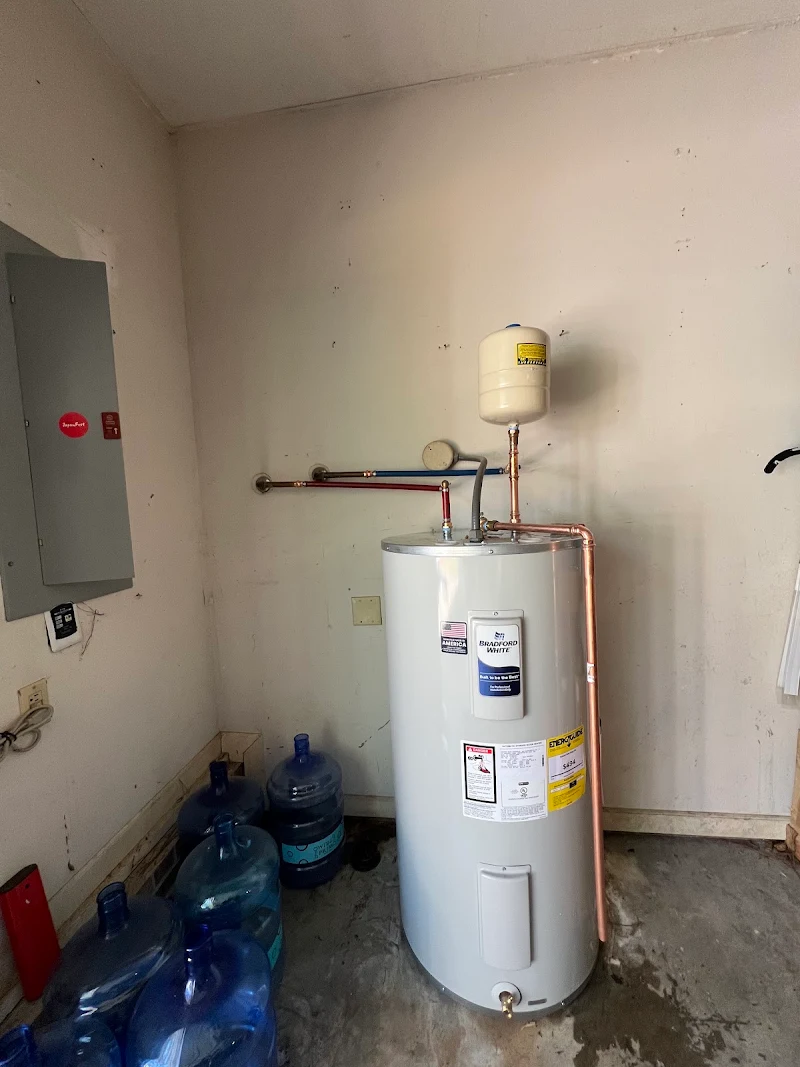
Then find the source. If water is coming from the tank itself, often at the bottom, A.O. Smith says the whole heater usually needs replacing. On Pinegate Drive in Greenville, water around the base turned out to be a hole in the bottom of the tank; we replaced it with a Bradford White 50-gallon the same day. If it's the temperature and pressure relief valve, or the pipe running down from it, the valve may be doing its job. South Carolina's code requires it to open at no more than 150 psi and 210°F. A.O. Smith says household water pressure should be 50 to 60 psi and no higher than 80.
A common reason a relief valve drips is thermal expansion. When a house has a check valve or pressure-reducing valve at the main, the water heated in the tank can't expand back into the street, so pressure climbs with every heating cycle. Rheem's manual is direct: replacing the relief valve won't correct it, and Rheem's suggested fix is an expansion tank on the cold line. Never plug a relief valve. If the valve keeps dripping after its lever is lifted and snapped back, A.O. Smith says to replace the valve.
Other sources are smaller. A drain valve at the bottom that isn't fully closed, or has failed. Loose or failing connections: off Country Club Road in Greer, a ruptured CPVC line connected to the heater caused a major leak. On an electric heater, the gaskets around the elements. And on a gas heater, condensation, which A.O. Smith says can be mistaken for a leak.
Where a leak would cause damage (a closet, an attic, a finished floor), South Carolina's code requires the heater to sit in a pan at least 1 1/2 inches deep, drained by a pipe at least 3/4 inch to an indirect waste receptor, or outside, where it ends 6 to 24 inches above the ground. On a replacement, a pan drain isn't required if there wasn't one before.
Signs You May Need Water Heater Leaking
- Water pooling around the base of the heater
- Rust or corrosion at the bottom of the tank
- Water dripping from the relief valve or its discharge pipe
- A wet drain valve at the bottom front
- Water at the pipes on top of the heater
- A leak with no water on the floor until the heater runs
What's Included
- Same-day water heater replacement when the tank has failed
- Temperature and pressure relief valve replacement
- Relief valve discharge piping correction
- Thermal expansion tank installation
- Drain valve replacement
- Hot and cold connection replacement
- Drain pan replacement
Why Choose Us
- We tell you whether it's the tank or a part before quoting
- Thermal expansion fixed at the cause, not just the valve
- Licensed in South Carolina and North Carolina
- Veteran-owned local plumber in Greer
Water Heater Leaking FAQ
Water Heater Leaking Near You
We provide water heater leaking to homeowners and businesses across the Upstate SC area. Select your city to see local service info.